A Pause at Home or a Change of Scene?
A pause at home or a change of scene can suit different kinds of fatigue; use attention and convenience to choose a break that feels distinct.
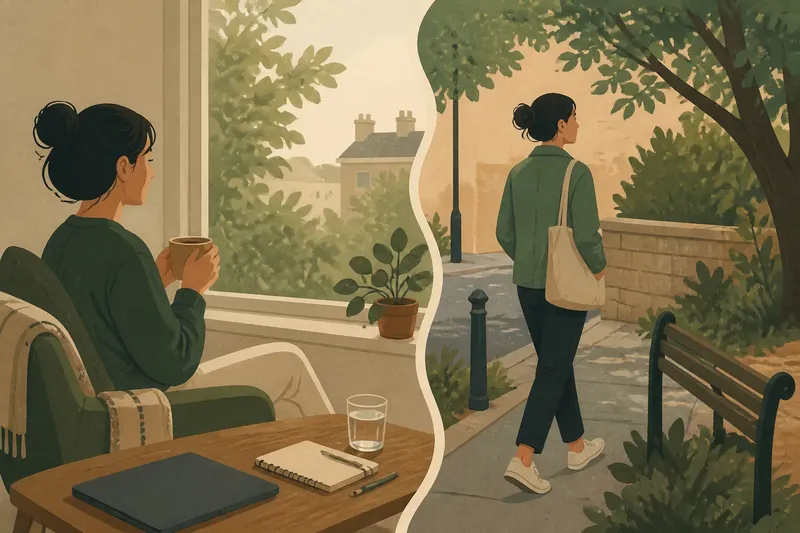
Should you take a pause at home or change your surroundings? The answer often depends on whether your attention needs less input or a different focus. A pause does not have to involve a special routine: it can be a few quiet minutes by the window, or a brief walk to a nearby place that feels separate from the task you have left behind.
Notice what your attention is doing
Staying put can help when the room is already calm and the main demand is effort. If you have been reading, sorting papers or concentrating on a screen, shifting to a chair away from the desk may be enough. The useful change is modest: you stop feeding the same task, without adding a new destination to manage.
A different setting can help when the surroundings have become part of the mental clutter. A busy kitchen, a shared living room or a desk crowded with unfinished work may keep drawing your eyes back to what needs doing. A change of scene gives attention something else to register: the sound of a street, the shape of a tree, or the feel of cooler air.
These are not fixed remedies for particular moods. They are practical distinctions to notice. Ask whether you want fewer things competing for your attention, or a new, simple thing to attend to. That question is often more useful than asking which option counts as a proper break.
Staying home can make a pause easier to begin
Convenience matters because a pause that requires organising can become another task. If you are at home, you can leave the laptop closed, put your phone face down and sit where you are not looking directly at work. A cup of tea or a glass of water can mark the change, but it need not become a ritual with rules.
Choose a spot with a clear boundary from the activity you are pausing. The far end of the sofa may feel different from the desk; a chair facing a window may offer a little distance from the kitchen counter. Even turning your seat away from a pile of laundry can reduce the sense that the next chore is already calling.
Still, staying home is not automatically restful. If other people need your attention, household noise is constant, or visible chores keep pulling you back into work, remaining in the same space may preserve the very demands you hoped to set down. In that case, consider a small change within the home first: a balcony, shared garden, hallway window or quieter room, if available.
A change of scene can give attention a clean edge
Going outside or to a nearby communal space can distinguish a pause from the work around it. A short walk to the end of the street, a seat in a courtyard or a visit to a local library foyer may give your eyes and ears different material. You do not need to make the outing productive. Its point can simply be to step out of the visual field that has held your attention.
The new setting also brings small demands. You may need shoes, a coat, keys or a suitable place to sit. A route may be noisy or crowded, and the weather may make going out less appealing. If those details take more effort than the change offers, the indoor option may be the kinder choice.
Think of the decision like choosing between turning a book over and opening it to a new page. The first gives the eyes a brief rest without changing the setting; the second offers fresh material, but asks you to move. Neither is better in itself. The useful choice is the one that fits the attention you have and the effort you can spare.
Choose by the kind of interruption you need
- If your focus feels worn but the room is quiet: stay nearby and move away from the task. Try a different chair or face a window rather than opening another screen.
- If the room keeps reminding you of unfinished work: move to a place with fewer visible prompts, even if that place is only another room.
- If you feel restless from being in one position: consider a short, unhurried change of scene, such as walking to a nearby bench or standing outside for a while.
- If setting out feels like a chore: do not turn the pause into an errand. Choose the simplest nearby spot and let convenience count as a real consideration.
- If other people share the space: make a clear, ordinary request for a few uninterrupted minutes where that is appropriate, or choose a place where you can be less available.
These are starting points, not rules. A pause can be brief and still feel distinct when the transition is clear: close the document, leave the materials where they are, and give your attention permission to land somewhere else. The next task can wait until the pause is over, rather than travelling with you in your thoughts.
Which kind of pause fits this moment?
Is staying home a real break?
It can be, if you step away from the task and let your attention settle somewhere else. A change of seat or view may be enough when home feels calm rather than demanding.
Should I go outside to clear my head?
Going outside may offer a different set of sights and sounds, which can make the pause feel separate from indoor work. If getting ready or dealing with the surroundings feels burdensome, staying in is a reasonable alternative.
What if I keep thinking about the task?
Try making the boundary more visible: close the work, put its materials aside and move to a spot that does not face them. If the thoughts return, you can notice them without treating the pause as a failure.
How do I know whether to stay or go?
Ask whether you need less stimulation or a new focus, then check how much effort each option requires. The more convenient choice is not a lesser one if it lets you disengage.
Let the pause remain small
Say you have finished a demanding stretch of desk work, and the living room is quiet but your eyes keep returning to an open notebook. You close it, leave your phone aside and sit by the window; the expected result is a few minutes in which the notebook is no longer directing your attention. If the room were noisy and full of interruptions instead, stepping into the shared garden might offer a clearer break, provided the short trip did not feel like another obligation.
The point is not to find a perfect setting. It is to notice whether your surroundings are helping or hindering the kind of pause you want. When deciding between a pause at home and a change of scene, let attention suggest the direction and convenience set the scale. A small, workable shift is often easier to choose again than an elaborate break you have to talk yourself into.