A Low-Key Evening Wind-Down with What You Have
An evening wind-down can feel less hurried with a clear stopping cue, a small transition and a comfortable activity you already have at home.
What would make the last part of tonight feel less hurried without turning it into another task? An evening wind-down can begin with a small decision: choose when to stop the day’s active demands, then make a gentle transition into something comfortable that is already available.
This is not a perfect bedtime routine or a promise of better sleep. It is a way to give an ordinary evening a little shape, especially when chores, messages or unfinished plans keep tugging at your attention. The aim is modest: to notice that one part of the day is ending and make the next part easier to inhabit.
An evening wind-down starts with a boundary, not a programme
“Wind-down” can sound like a sequence of prescribed habits: dim the lights, prepare a drink, write in a journal, stretch, read, and be in bed by a particular time. A long sequence may suit someone who enjoys it, but it can also make rest feel like a performance. For a low-key version, the useful question is not how many activities to fit in. It is what you are ready to stop doing for now.
That boundary might be the end of paid work, the moment you put away the dinner dishes, or the point when you decide not to begin another household job. It need not coincide with bedtime. People share homes, work different hours and have responsibilities that do not fall neatly into a schedule. Choose a stopping point that makes sense for this evening, not an idealised evening you rarely have.
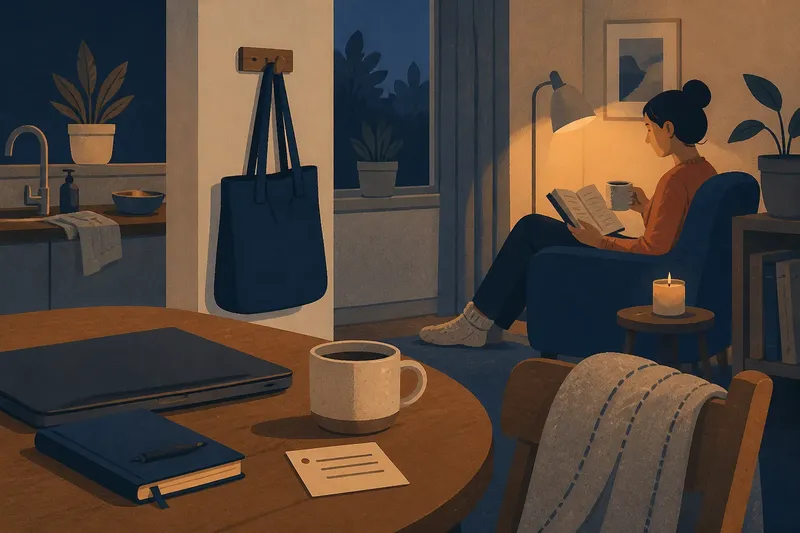
A stopping cue gives that choice a visible or audible form. You might close the laptop, put a notebook on a shelf, turn off a work lamp, or say aloud, “I’m leaving this until tomorrow.” The cue is not a magic signal; it is a reminder to yourself. Its value lies in making an otherwise vague intention easier to recognise.
Try to make the cue specific enough to act on. “I should slow down” can be difficult to interpret while you are still answering messages. “After I send this reply, I’ll close the laptop” gives you a clear point at which to change course. If a genuinely urgent task remains, adapt the boundary: finish that task, then use a new cue rather than treating the entire evening as lost.
Choose a stopping cue that fits the evening you have
The best cue is often attached to something that is already happening. It might follow the last work call, the end of a meal, or the moment a shared room becomes quieter. Attaching the decision to an existing event avoids creating another reminder to manage and helps the transition feel part of ordinary life.
It can help to distinguish a stopping cue from a time target. A clock can be useful if you need to protect a particular part of the evening, but a rigid time may be impractical when dinner runs late or a child needs attention. An event-based cue can move with the evening: after the kitchen is cleared, you stop taking on optional chores; after the last message you intend to answer, you close the device.
Consider what the cue is meant to stop. If your attention is still divided between work and home, a laptop closing may be enough. If you have been carrying a mental list of errands, you might write one brief note about the next action and leave the list where you can find it tomorrow. That is different from making a full plan. The note simply gives the unfinished item a place outside your immediate attention.
Say you finish a late meal and notice that you are about to start sorting a cupboard because it is in view. You could decide that clearing the plates is the final household task, put the cloth away, and say, “The cupboard can wait.” The observable change is small: you are no longer beginning a new job, and the evening has a clearer edge. It does not require the kitchen to be immaculate or your mind to become instantly quiet.
Make the transition small enough to repeat
Between stopping one kind of activity and starting another, a little transition can help. It might be as simple as moving from the table to a chair, putting the work bag by the door, washing your hands, or changing into softer clothes. The action is not valuable because it is special; it gives your body and attention a chance to catch up with the decision you have made.
Keep the transition proportionate. If you have only a few minutes, choose something that fits without rushing. If you share a room, the transition might be moving your mug and book to one end of the sofa rather than rearranging the space. If you are caring for someone, the pause may need to wait until they are settled. A transition that can bend is more useful than one that makes ordinary interruptions feel like failure.
Everyday objects can make this change easier to see. A notebook placed on a shelf is a little like putting a lid on a pot: it does not erase what is inside, but it marks a pause in handling it. Choose a simple physical action that communicates “not now” to you, rather than buying equipment or preparing a special setting.
Light and sound can also shape how a room feels, but there is no need to transform the whole home. You might switch off a bright desk lamp while leaving the lighting needed for cooking or caring for others. You might lower the volume of a programme rather than turning everything off. Think of comfort and practical needs first; a quieter atmosphere is a possibility, not an obligation.
Use what is already comfortable and available
The next part of the evening can be an activity that asks little of you and feels welcome in your actual circumstances. Reading a few pages, listening to familiar music, sitting with a warm drink, doing a crossword, or watching a programme you have already chosen may all serve. The point is not to select the most virtuous pastime. It is to choose something that does not immediately pull you back into the demands you just set aside.
“Comfortable” is personal and can change from one evening to another. A book may feel absorbing when you have energy and irritating when you are tired. A screen may help you relax, or it may keep you checking messages. Notice how a particular activity tends to leave you feeling in that moment, and adjust without turning the decision into a rule about what everyone should do.
It may be useful to distinguish a chosen activity from an automatic one. Reaching for a phone can be a deliberate way to enjoy a game or talk to a friend; it can also become an unplanned stretch of scrolling that leaves you more alert than you wanted. You do not have to ban the phone. You can choose a particular use, silence notifications that are not needed, or set it aside if you notice it is keeping the evening busy.
Make the activity easy to begin. Leave the book on the chair where you like to sit, keep the knitting beside the sofa, or choose the album before you settle down. These small arrangements are not a productivity system; they reduce the number of decisions between stopping and enjoying something. If nothing appeals, sitting quietly for a while is also a complete choice.
Where household needs or health circumstances shape what is comfortable, adapt the activity rather than forcing a standard routine. You may need to keep a phone nearby, stay within earshot, or choose something that can be interrupted. If sleep difficulties or distress are persistent and affecting daily life, a qualified health professional can offer advice suited to your situation.
What if the evening does not go to plan?
What should I do if I finish work late?
Keep the same idea but shorten the transition: close the work materials, note any next action you need to remember, and choose a modest activity that fits the time and energy left. There is no need to recreate a full routine or make up for the evening you did not have.
Can I use my phone as part of an evening wind-down?
Yes, if the way you use it feels comfortable rather than compulsory. Choose the activity deliberately, such as listening to music or messaging someone, and notice whether notifications or unplanned browsing are drawing you back into demands.
What if I live with other people?
Make the cue personal and compatible with the shared space: put away your own work things, change seats, or use headphones if that suits the household. A wind-down does not require everyone else to follow the same schedule or become quiet at the same time.
Does an evening wind-down have to happen every night?
No. It can be an option for evenings when a boundary and a small transition would help. If it does not fit a particular night, that is information about your circumstances, not a reason to judge yourself.
Let the routine stay responsive
A low-key evening wind-down works best as a flexible arrangement, not a test of consistency. Some nights the stopping cue will be obvious; on others, a family need, a late journey or an unfinished responsibility will change the plan. You can keep the underlying idea while changing its form: stop one optional demand, make a small transition, and choose a comfortable activity from what is available.
It is also fine to discover that a chosen activity is not helping tonight. You can put the book down, switch off the programme, or return to a practical task if something needs attention. That is not a breakdown in the routine. It is an adjustment based on what is actually happening, and it may be more caring than continuing out of obligation.
If you want to try an evening wind-down, make only one decision in advance: what will tell you that the day’s active demands are finished for now? The answer can change with the day. Once you reach that point, give yourself a small transition and use what you have—a chair, a familiar song, a book, or a few quiet minutes—to make the rest of the evening feel less hurried.